
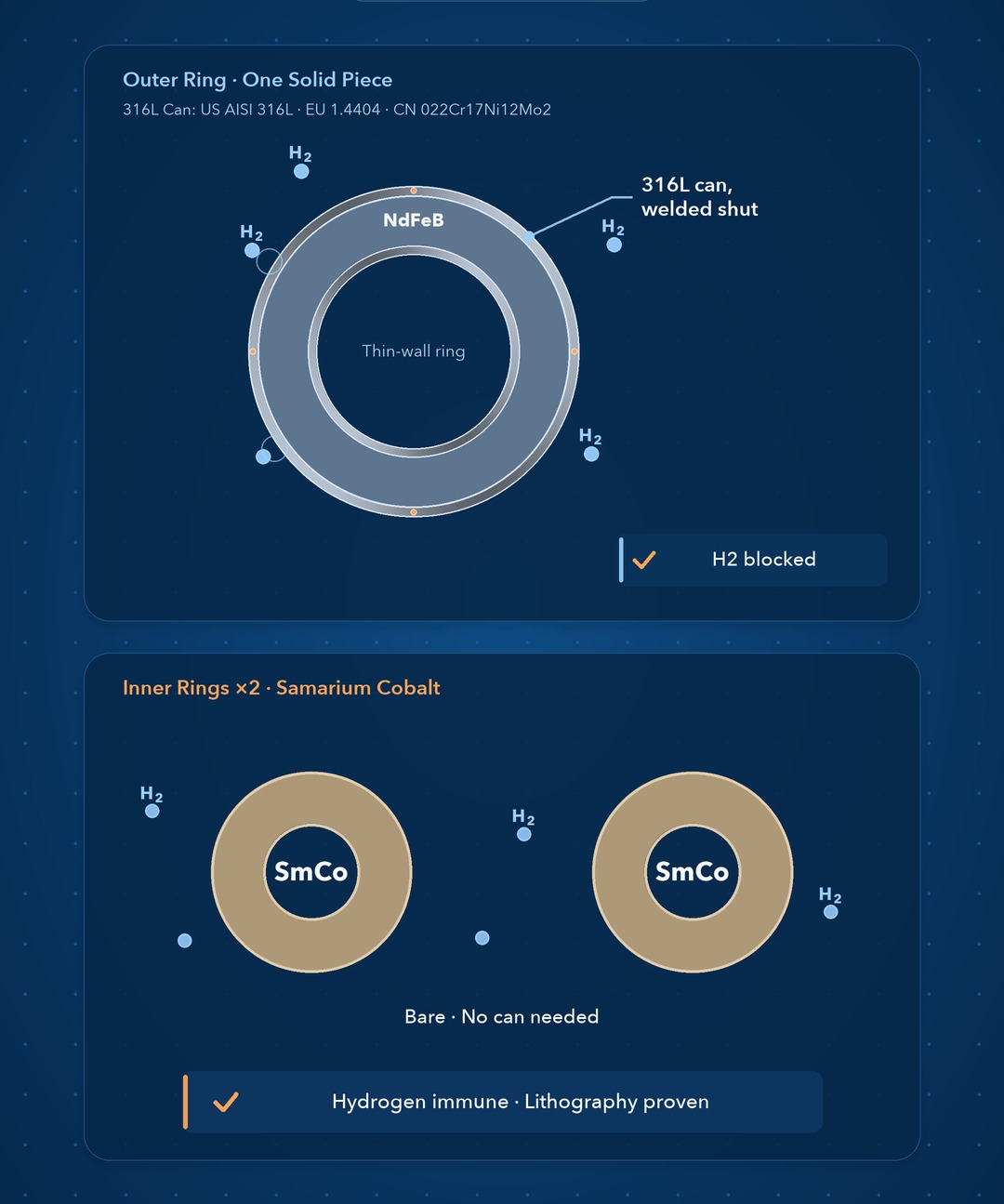
Choosing magnets in hydrogen vacuum comes down to survival once the chamber seals: hydrogen penetrates bare sintered NdFeB along grain boundaries until it swells and crumbles, while samarium cobalt (SmCo) resists hydrogen directly. On a precision optical maglev project, MagnetPeak split the build—laser-welding the outer NdFeB ring in 316L stainless steel and running bare SmCo inner rings.
A research institute building precision optical equipment reached out with a real deadline. Before cutting custom tooling, they wanted stock trial rings to verify their electromagnetic simulation against hardware. We shipped those trial rings the very next day—before their institute's payment paperwork had even cleared—because validating real physics first always beats arguing over spreadsheets.
Why magnets in hydrogen vacuum need a split material strategy
The tricky part of their magnetic levitation assembly was the environment: a sealed vacuum chamber containing hydrogen gas. In sintered neodymium magnets, hydrogen enters along the Nd-rich grain boundaries between Nd₂Fe₁₄B grains, causing the alloy to swell, crack, and crumble from within. Once that chamber is sealed shut, nothing inside can ever be replaced.
So we split the assembly into two practical paths rather than forcing one material to do everything:
| Assembly Position | Magnet & Enclosure Choice | Why It Worked in Hydrogen Vacuum |
|---|---|---|
| Large Outer Ring | One solid sintered NdFeB piece sealed inside a thin laser-welded 316L can (US: AISI 316L · EU: 1.4404 · CN: 022Cr17Ni12Mo2) | Preserves solid-ring magnetic strength while the non-magnetic welded stainless barrier blocks hydrogen contact |
| Two Small Inner Rings | Uncoated samarium cobalt (SmCo) rings | Inherently resistant to hydrogen embrittlement; proven in lithography hydrogen atmospheres with zero enclosure wall loss |
As samarium-cobalt magnet metallurgy shows in high-vacuum lithography equipment, bare SmCo operates cleanly in hydrogen atmospheres without plating or canning. Keeping the two small inner rings bare saved radial space where a stainless wall would have cost too much air-gap volume.
Being honest about a 10-micron welded can tolerance
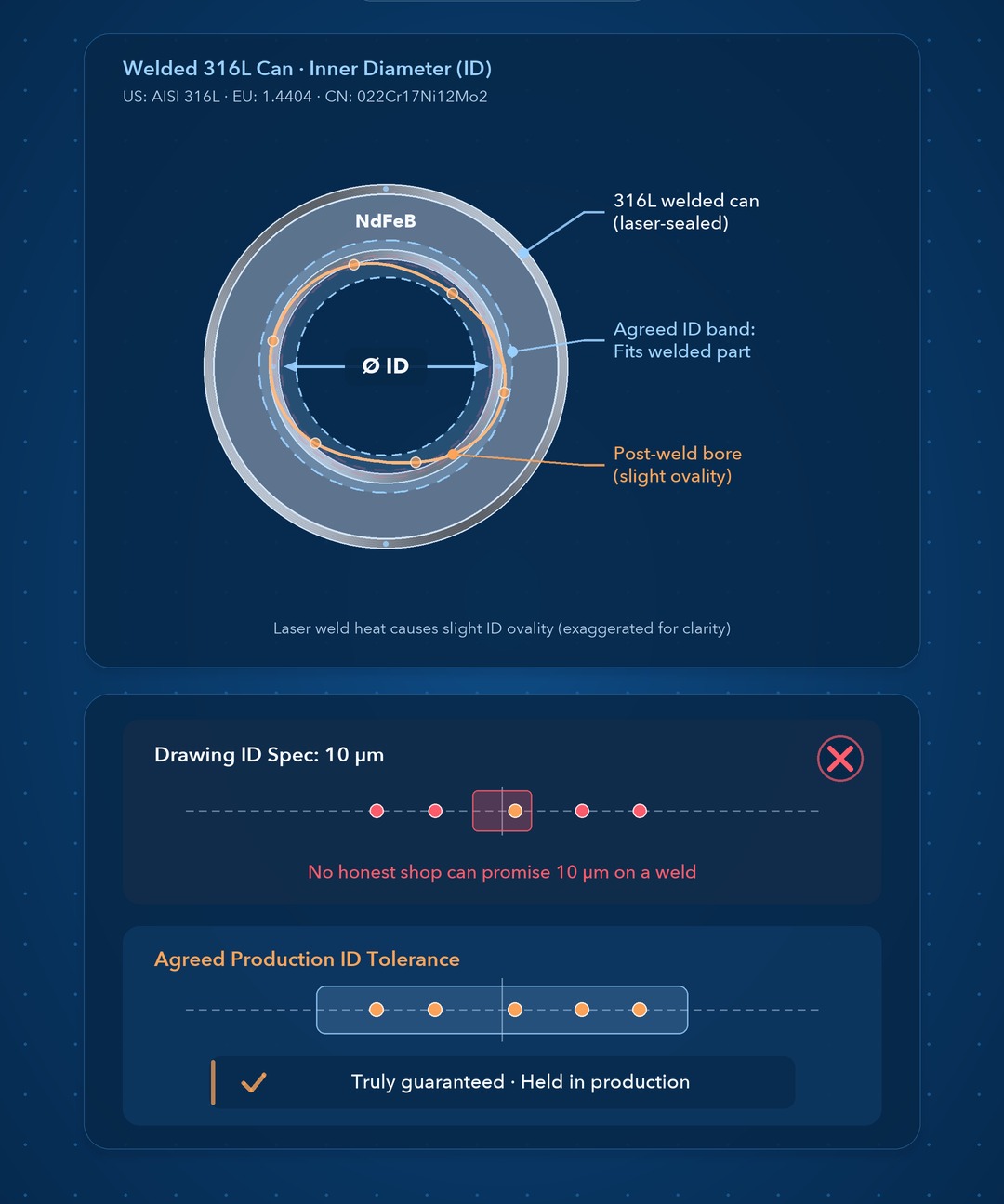
The hardest conversation on this project was not magnetic grade—it was tolerance. The customer's initial drawing specified 10 µm (±0.01 mm) on the inner diameter (Ø ID) of the welded 316L stainless can.
We were straight with them: no honest shop can guarantee 10 µm across a thin laser-welded stainless enclosure. Weld heat introduces slight bore ovality. Telling a customer "yes" just to win the PO guarantees rejection later. Following how MagnetPeak works on custom assemblies, we sat down with their engineering team, explained the weld distortion physics clearly, and agreed on a realistic production tolerance band we could truly guarantee—and we held it on every shipped ring.
Frequently asked questions
Why not build the entire hydrogen-vacuum assembly out of SmCo?
When a large outer ring must remain one solid high-output piece inside a tight envelope, sintered NdFeB delivers stronger room-temperature flux density than SmCo. Encapsulating that single NdFeB ring in thin welded 316L gives the assembly both high outer force and hydrogen immunity.
What stainless steel equivalents match 316L for welded magnet cans?
MagnetPeak specifies non-magnetic austenitic 316L under cross-regional equivalents US AISI 316L, EU 1.4404, and CN 022Cr17Ni12Mo2 so material certificates align whether prototypes are tested in North America, Europe, or Asia.
How should we start a custom vacuum magnet assembly review?
Send your envelope drawing, operating atmosphere, bakeout temperature, and realistic mating clearances through the MagnetPeak contact form—that is the work we love, solving the real environment the magnet has to live in.