
Can a magnet pull hard on one side and barely move a compass on the other? That is what a Halbach array motor rotor delivers when adjacent magnet pieces rotate their magnetization step by step—pushing flux across the working air gap while letting MagnetPeak drop heavy steel back iron to save rotor weight.
Why does a Halbach array concentrate flux on one side?
A normal magnet wastes half its energy spreading flux symmetrically on both faces. When you rotate the magnetization direction across neighboring segments—north, diagonal, south, diagonal again—the fields constructively reinforce on the front working surface and cancel behind it. On the active face you get concentrated pull; on the back side a compass barely reacts.
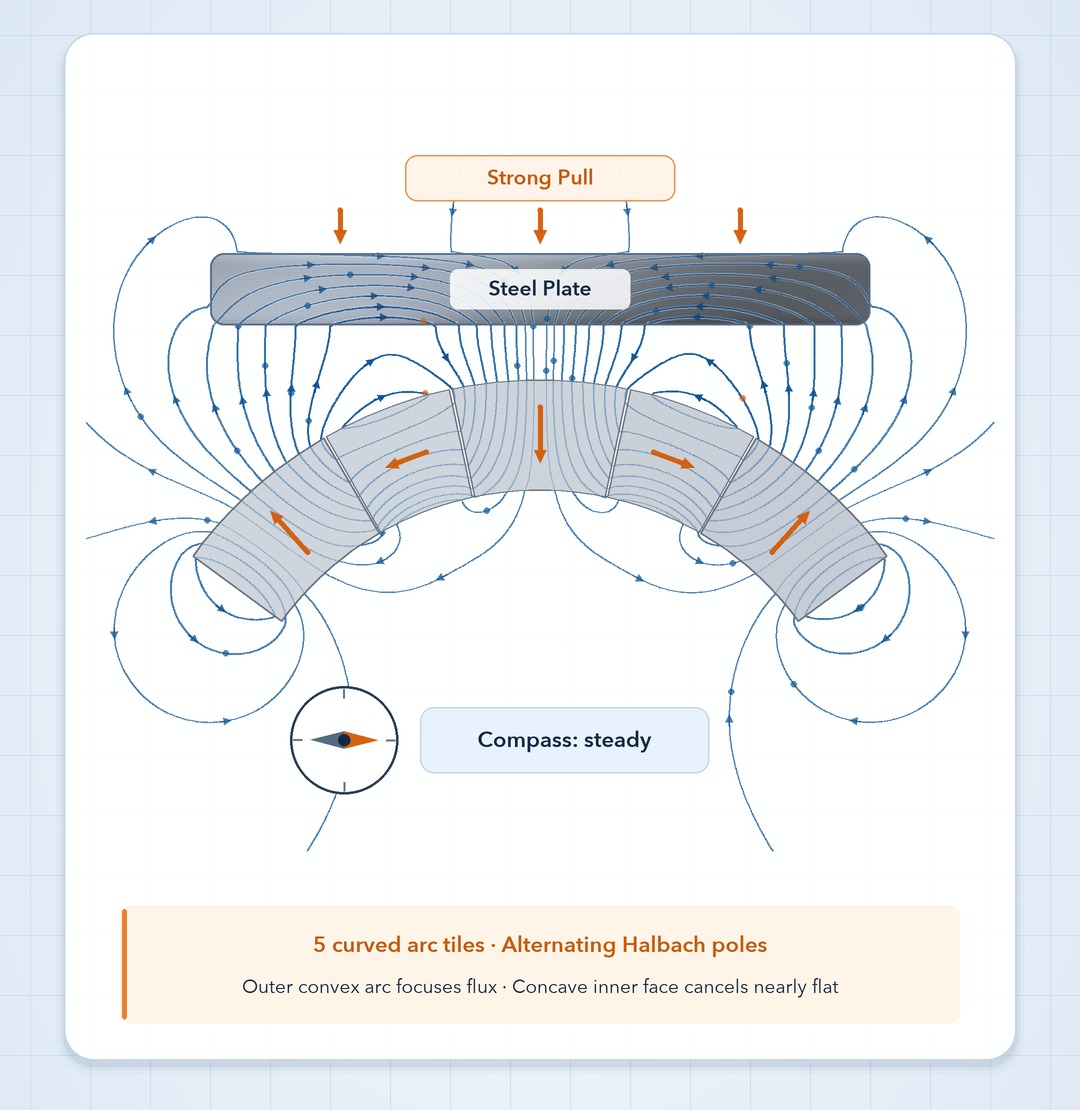
In a motor, every ounce of magnetic flux belongs in the working air gap driving torque—not leaking out the back of the rotor. Because a Halbach magnetic circuit closes its flux path inside the magnet ring itself, engineers can replace a thick steel back-iron yoke with a thin aluminum or composite hub. On our Halbach rotor manufacturing builds and carbon fiber sleeved rotors, dropping that steel back iron directly lowers rotating mass and rotor inertia.
What are the three manufacturing trade-offs behind a Halbach array?
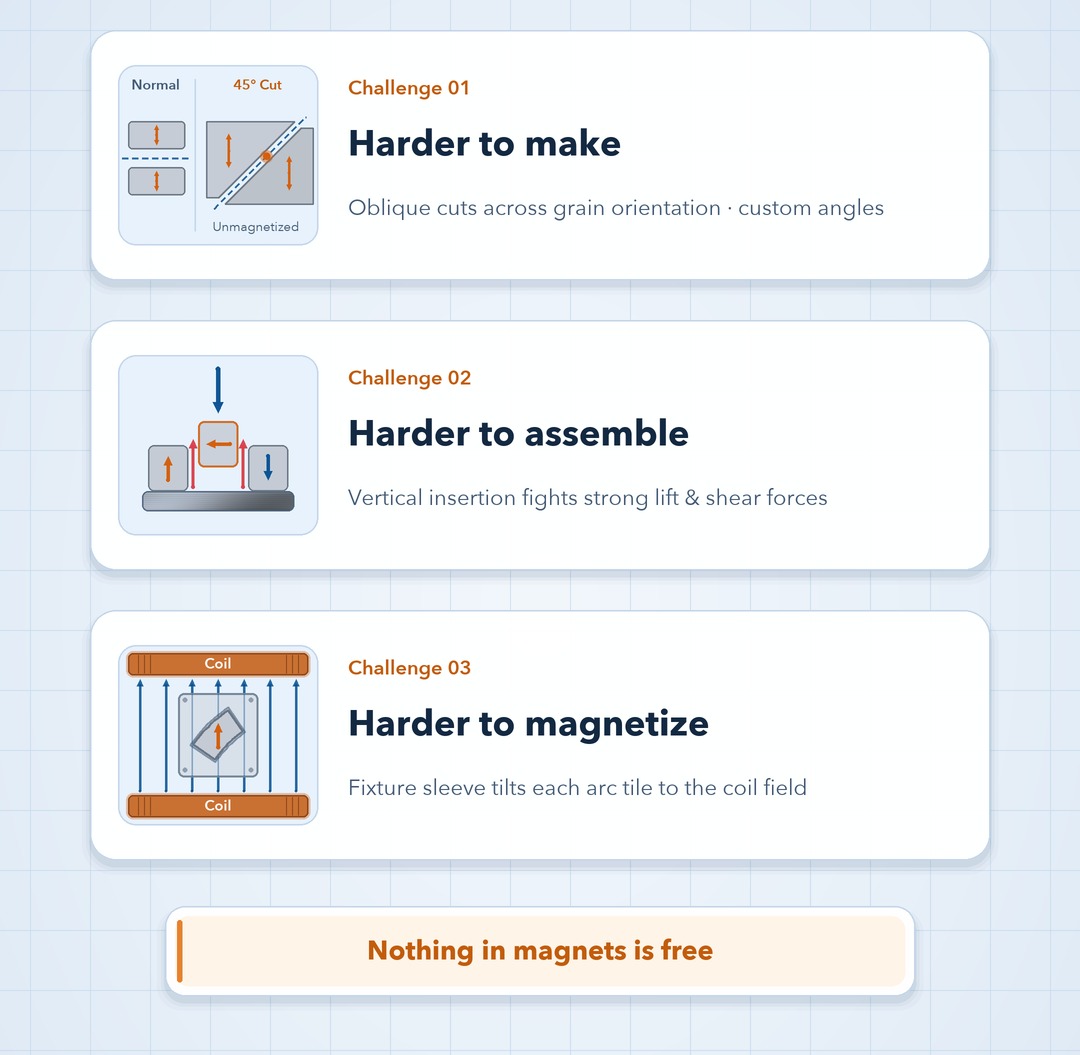
Nothing in magnets is free. The magnetic physics is clean on paper, but turning a rotated segment layout into repeatable hardware forces three real costs on the shop floor:
| Production Stage | What Happens on the Floor | Design & Budget Consequence |
|---|---|---|
| 1. Machining | Rotated segments require oblique (for example 45°) cuts across the pressed grain orientation rather than simple straight slices | Higher raw-block waste, tighter orientation verification, and longer wire-cutting cycle times |
| 2. Assembly | Pre-magnetized rotated pieces repel adjacent segments with strong lift and shear forces during insertion | Requires rigid assembly fixtures, controlled 0.05 mm to 0.15 mm adhesive bond lines, and post-assembly OD grinding |
| 3. Magnetizing | Angled arc tiles cannot sit flat inside a simple north-south parallel coil | Needs custom tilted fixture sleeves (such as 20° pockets) or multi-pole pulse coils matched to rotor grade |
When is a Halbach array motor rotor worth the extra complexity?
We review every magnetic circuit simulation honestly before recommending segmented Halbach tooling. If your motor housing has room for a 3 mm to 6 mm steel yoke and cost matters more than rotor inertia, conventional arc segments on steel are simpler to machine, glue, and balance.
When your target is maximum flux on one side and near-zero field on the back—whether in an ultra-lightweight UAV motor rotor or a precision optical bench setup like our NV-center diamond Halbach build—Halbach earns its keep. MagnetPeak pairs those segments with N48SH or N45UH grades when continuous rotor heat reaches 120 °C to 150 °C.
Frequently asked questions
Can a Halbach rotor really run without steel back iron?
Yes. Because adjacent rotated tiles complete the magnetic return path inside the magnet wall itself, flux leakage into the inner bore is minimal, allowing a lightweight aluminum, titanium, or non-magnetic stainless hub instead of ferromagnetic steel.
Why do Halbach rotors cost more per pole than standard arc rotors?
Each pole pair typically splits into 4 distinct segments rather than 2, adding oblique grain-orientation cutting, angled magnetizing fixtures, higher-force assembly jigs, and post-cure sleeve containment or OD grinding.
What should we send MagnetPeak to evaluate a Halbach rotor build?
Share your rotor OD, ID, stack length, pole count, working air gap, target speed (RPM), and peak operating temperature through our engineering contact form, and we will review manufacturability from 1-piece prototypes through production.