
What Are Carbon Fiber Sleeved Rotors?
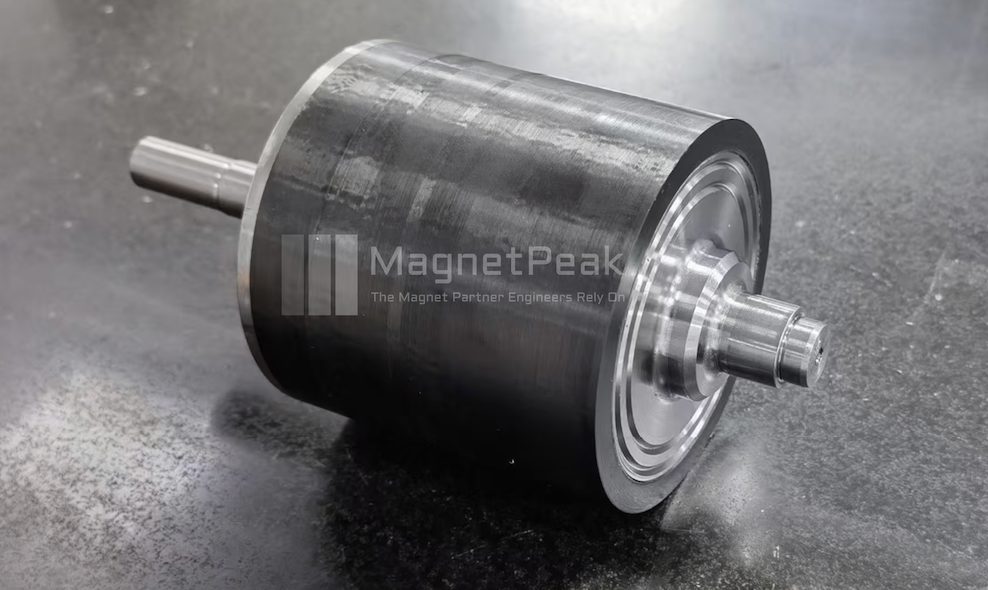
Carbon fiber sleeved rotors are permanent magnet rotor assemblies reinforced by carbon fiber composite sleeves. These sleeves are not decorative outer covers. They are part of the rotor’s high-speed mechanical structure, helping the assembly remain stable under centrifugal loading, temperature change, vibration, and precision finishing requirements.
In many projects, carbon fiber sleeves are used to help improve rotor integrity at high speed. Depending on the rotor design, the sleeve may directly help retain magnets near the outer diameter, or it may serve as an additional reinforcement structure for the rotor assembly as a whole. For this reason, carbon fiber sleeved rotors should not be understood as a single fixed rotor format, but as a high-speed rotor solution where composite reinforcement becomes part of the design.
For MagnetPeak, carbon fiber sleeved rotors are not simply rotors with an added sleeve. They are magnetic and mechanical systems where magnet material, rotor structure, sleeve thickness, air gap, pre-stress, adhesive condition, grinding allowance, thermal condition, and dynamic balance may all need to be reviewed together.
This is especially important in high-speed motor systems where rotors must deliver strong magnetic output while remaining mechanically stable under demanding speed, balance, and thermal conditions. A thinner sleeve may help reduce the effective magnetic gap, but it must still provide enough structural margin. A thicker sleeve may improve mechanical security, but it can also affect air gap, rotor diameter, and final performance. The right design is a balance between magnetic output, mechanical safety, and manufacturability.
At MagnetPeak, carbon fiber sleeved rotor projects are reviewed from both the magnetic and mechanical sides. Before recommending a sleeve route, we first look at whether the rotor structure, available radial space, operating conditions, finishing process, and validation requirements can work together. The goal is not simply to add a sleeve, but to build rotor assemblies that can be manufactured, finished, balanced, and verified with reasonable engineering confidence.
Why High-Speed Rotors Need Retention Systems
In high-speed permanent magnet rotors, mechanical stability is not defined by magnetic performance alone. As rotational speed increases, the rotor assembly must withstand centrifugal force, thermal stress, vibration, machining tolerance, and dynamic balance requirements. For this reason, rotor integrity should be reviewed as a system rather than as an isolated material choice.
Carbon fiber sleeves are often discussed in terms of strength, low weight, and low electrical conductivity, but their real value depends on how they function within the complete rotor structure. In some projects, the sleeve helps support magnet retention near the outer diameter. In others, it acts more broadly as a high-speed reinforcement or containment structure. In both cases, the sleeve should be treated as part of the rotor’s retention system rather than as a simple protective layer.
This is also why carbon fiber sleeves should be considered early in the design stage. Sleeve thickness affects the effective magnetic gap and rotor diameter. Pre-stress affects structural support. Adhesive condition, rotor geometry, and grinding allowance affect the finished assembly. Dynamic balancing affects whether the rotor can run safely at speed. These factors are connected, and changing one of them may influence the others.
At MagnetPeak, carbon fiber sleeves are reviewed according to the actual rotor task they are expected to solve. The key question is not whether a rotor can be covered with carbon fiber, but whether the proposed sleeve structure can contribute to a rotor assembly that is practical to manufacture, finish, balance, and validate.
Carbon Fiber Sleeves vs. Metal Sleeves
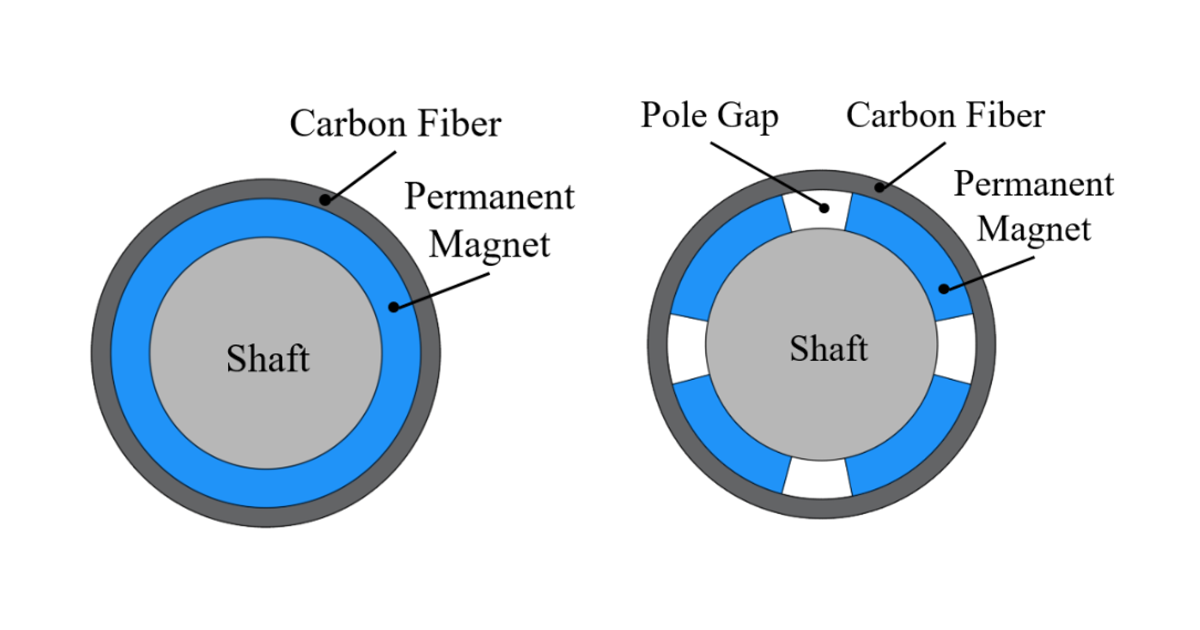
Carbon fiber sleeves and metal sleeves are both used to improve the mechanical integrity of high-speed permanent magnet rotors. Their purpose is similar: to help the rotor structure remain stable under high rotational speed. However, they behave very differently in magnetic, mechanical, thermal, and manufacturing terms.
For many high-speed permanent magnet rotors, carbon fiber sleeves are attractive because they offer high hoop strength, low density, and low electrical conductivity. Compared with conductive metal sleeves, carbon fiber composite sleeves can help reduce sleeve-related eddy current loss, which is important when the rotor operates in a changing electromagnetic field. Their low density also helps reduce added rotor inertia.
Another important advantage is radial space. In compact motors, the sleeve is not just a mechanical part. It also becomes part of the effective magnetic gap. If the sleeve can be made thinner while still providing enough mechanical margin, the rotor may retain better magnetic performance. This is one reason carbon fiber sleeves are often considered for high-speed, high-power-density motor designs.
Metal sleeves, however, should not be dismissed. High-strength non-magnetic metal sleeves may offer better thermal conduction, easier handling, more predictable machining behavior, and mature assembly routes in some projects. For rotors where heat removal is difficult, where the sleeve must tolerate harsh handling, or where the process route is already validated, metal sleeves may still be practical.
Carbon fiber sleeves also introduce their own challenges. Their strength depends heavily on fiber direction, winding quality, resin system, curing process, sleeve thickness control, and final grinding. They are strong in the designed hoop direction, but they should not be treated as uniformly strong in every direction. Edge damage, machining defects, poor bonding, or uncontrolled pre-stress can reduce the value of the sleeve.
This is why MagnetPeak does not treat carbon fiber sleeves and metal sleeves as simple substitutes for each other. The choice should be reviewed together with rotor speed, magnet layout, allowable air gap, thermal condition, sleeve thickness, production volume, balancing requirement, and validation method. In some projects, carbon fiber sleeves are the better route. In others, metal sleeves or hybrid retention structures may be more realistic.
The practical question is not which sleeve material sounds more advanced. The question is which retention route can deliver enough mechanical safety while preserving magnetic output, manufacturability, and long-term reliability.
| Factor | Carbon Fiber Sleeves | Metal Sleeves |
|---|---|---|
| Electrical conductivity | Low, helps reduce sleeve-related eddy current loss | Higher, may increase eddy current loss depending on material and motor design |
| Density | Low, helps reduce added rotor inertia | Usually higher |
| Sleeve thickness | Can be favorable when hoop strength and process control are sufficient | May require more radial space depending on strength requirement |
| Thermal path | Usually weaker for heat conduction | Often better for heat transfer |
| Machining and handling | Requires careful grinding and edge protection | Often more predictable in conventional machining |
| Design sensitivity | Strongly affected by fiber direction, winding, resin, curing, and pre-stress | Strongly affected by alloy choice, interference fit, stress, and eddy current control |
How Carbon Fiber Sleeves Are Applied to Rotors
Carbon fiber sleeves can be applied to permanent magnet rotors in different ways. The right route depends on rotor geometry, speed target, magnet layout, sleeve thickness, tolerance requirement, production volume, and validation method. For high-speed rotors, the sleeve process should not be selected only because it looks strong or advanced. It must match the mechanical and magnetic requirements of the assembly.
One common route is to use pre-formed carbon fiber sleeves. In this approach, the sleeve is manufactured separately and then assembled onto the rotor with controlled fit, bonding, or thermal assistance. This route may be practical when sleeve dimensions can be controlled in advance and the rotor geometry is suitable for assembly. It can also be useful when repeatability and process separation are important.
Another route is direct carbon fiber winding on the rotor. In this process, carbon fiber is wound around the rotor assembly with controlled tension and resin system. This method can help create hoop reinforcement around the rotor, but the final result depends heavily on winding tension, fiber angle, resin curing, sleeve thickness control, and post-processing. It is not simply “wrapping carbon fiber around magnets.”
Some projects may require hybrid or project-specific retention structures. For example, carbon fiber sleeves may work together with adhesive bonding, end rings, non-magnetic metal parts, rotor bridges, or other mechanical features. In these cases, the sleeve is only one part of the full retention system. The final design must consider how each feature contributes to rotor integrity at speed.
After sleeving, the rotor usually still needs precision finishing. Grinding may be required to achieve the final outer diameter, roundness, and surface condition. Dynamic balancing may also be needed before the rotor can be evaluated for high-speed operation. These steps are not secondary details. They can influence sleeve thickness, rotor runout, balance quality, and final reliability.
At MagnetPeak, we review the sleeve route before treating the project as manufacturable. The review may include available radial space, magnet arrangement, target speed, winding feasibility, sleeve thickness, curing condition, grinding allowance, balancing requirement, and inspection plan. The goal is to choose a route that can be produced and verified, not just one that looks good in theory.
Sleeve Thickness, Air Gap, and Pre-Stress Must Be Balanced
Carbon fiber sleeves are often selected because they can provide high hoop strength with relatively low thickness and low weight. However, sleeve design should not be simplified into “the thinner, the better” or “the stronger, the better.” In high-speed permanent magnet rotors, sleeve thickness, magnetic air gap, and pre-stress are connected.
From the magnetic side, sleeves occupy radial space. Even when carbon fiber composites are non-magnetic and have low electrical conductivity, the sleeve still increases the effective distance between the rotor magnets and the stator. In compact high-speed motors, this added distance may reduce magnetic output, torque density, or motor efficiency. This is why sleeve thickness must be considered as part of the magnetic gap, not only as a mechanical dimension.
From the mechanical side, sleeves must provide enough retention margin for high-speed operation. Thin sleeves may help preserve magnetic performance, but they may not provide sufficient reinforcement if rotor speed, magnet mass, rotor diameter, or overspeed requirements are demanding. Thicker sleeves may improve structural safety, but they can also increase rotor diameter or consume valuable air-gap space.
Pre-stress adds another layer of complexity. The purpose of pre-stress is not simply to make sleeves tight during assembly. The important question is whether useful compression remains after curing, grinding, temperature change, acceleration, overspeed testing, and long-term operation. Resin behavior, winding tension, thermal expansion mismatch, sleeve thickness, and machining allowance may all influence the final retention condition.
This is why carbon fiber sleeved rotors should be reviewed as coupled magnetic and mechanical designs. If the sleeve is too conservative, motor performance may suffer. If the sleeve is too aggressive, the rotor may not have enough mechanical safety margin. The best solution is not always the thinnest sleeve or the strongest theoretical sleeve, but the structure that can balance magnetic output, stress control, process stability, and validation.
At MagnetPeak, sleeve thickness and pre-stress are reviewed together with rotor speed, magnet dimensions, rotor outer diameter limit, air-gap allowance, operating temperature, grinding allowance, and balancing requirement. This helps avoid designs that look efficient on paper but become difficult to manufacture, finish, or verify in real high-speed applications.
Precision Finishing and Dynamic Balancing Matter
Carbon fiber sleeved rotors are not finished once the sleeves are applied. For high-speed permanent magnet rotor assemblies, post-processing can be just as important as sleeve design itself. The final outer diameter, roundness, surface condition, and balance quality all affect whether the rotors can be used safely and consistently at speed.
After carbon fiber sleeving, precision grinding may be required to achieve the target rotor outer diameter and surface accuracy. This step must be controlled carefully because grinding does not only change dimensions. It may also affect sleeve thickness, surface integrity, edge condition, and the final tolerance chain of the rotor assembly. Poor grinding control can reduce the value of a well-designed sleeve.
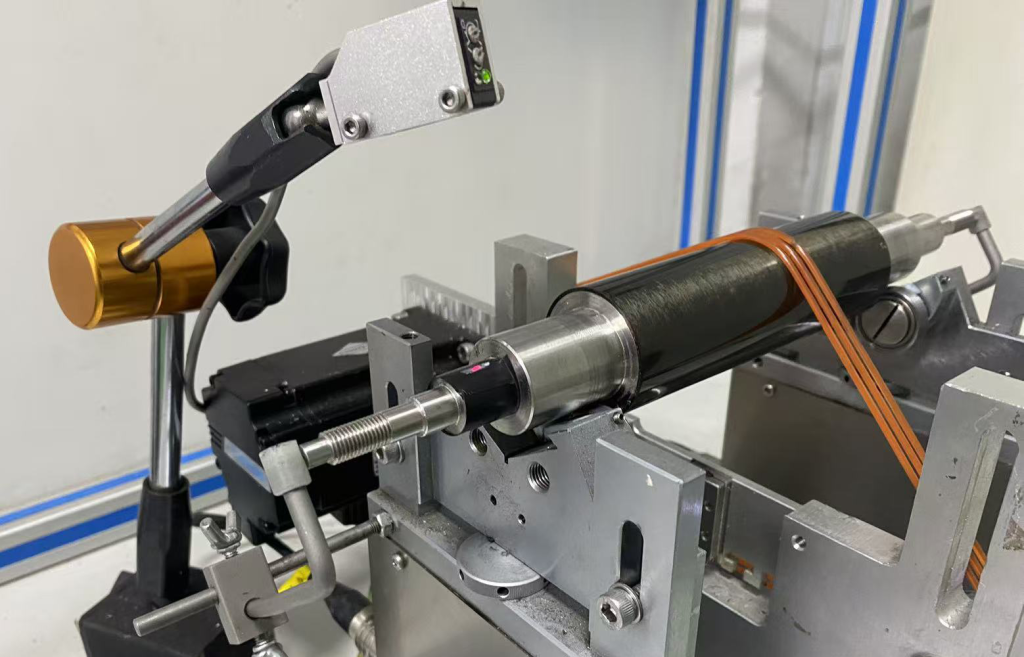
Dynamic balancing is another critical step. Even small mass differences may become serious at high rotational speed. Magnet positioning, adhesive distribution, sleeve thickness variation, resin distribution, grinding allowance, and end-region features can all influence rotor balance. For this reason, balancing should not be treated as a final cosmetic correction, but as part of the complete rotor validation process.
In some projects, balancing requirements may be relatively straightforward. In others, especially compact high-speed rotors, spindle motor rotors, turbo machinery rotors, or high-power-density motor rotors, balance grade, testing speed, fixture method, and inspection report format may need to be discussed before production begins. A rotor structure that cannot be finished or balanced properly is not a reliable design, even if the magnetic design looks strong.
At MagnetPeak, we review finishing and balancing requirements early in carbon fiber sleeved rotor projects. The review may include grinding allowance, final OD tolerance, roundness, sleeve surface condition, balance grade, inspection method, and whether prototype testing or overspeed validation is needed. The goal is to avoid designs that can be assembled, but cannot be finished and verified with confidence.
What MagnetPeak Reviews Before Recommending Carbon Fiber Sleeved Rotors
Carbon fiber sleeved rotors should be reviewed before the sleeve route is fixed. The sleeve material is only one part of the design. Rotor speed, magnet layout, sleeve thickness, air gap, finishing process, thermal condition, and balancing requirements all affect whether the final rotor assembly can be manufactured and verified with confidence.
At MagnetPeak, we usually review the following points before recommending carbon fiber sleeved rotors:
- Rotor speed and overspeed requirement. The target operating speed is the starting point. The review should also consider overspeed margin, acceleration conditions, and whether the rotor will need validation beyond normal operating speed.
- Rotor type and magnet layout. Carbon fiber sleeves may be used with different permanent magnet rotor structures. The review should consider whether the sleeve is mainly expected to retain magnets near the outer diameter, reinforce the rotor structure, or provide additional containment for high-speed operation.
- Magnet material and grade. Neodymium magnets and Samarium Cobalt magnets behave differently under temperature, stress, and magnetic loading. Magnet grade, coercivity, magnet dimensions, and magnetization direction should be checked together with the sleeve design.
- Sleeve thickness and available radial space. The sleeve must provide enough mechanical support, but it also occupies radial space. In compact motors, sleeve thickness becomes part of the effective magnetic gap and may influence magnetic output, torque density, and final rotor diameter.
- Air gap and magnetic performance. Carbon fiber sleeves are non-magnetic, but they still increase the distance between the magnet region and the stator. For performance-sensitive motors, the sleeve cannot be reviewed only as a mechanical part. It must also be considered in the magnetic circuit.
- Pre-stress and retention margin. Useful compression after assembly is more important than theoretical sleeve strength. Winding tension, sleeve fit, resin behavior, thermal expansion, curing, grinding, and speed conditions may all influence the final retention margin.
- Adhesive and surface preparation. For many rotor assemblies, adhesive bonding still plays an important role. Surface treatment, adhesive thickness, curing condition, and compatibility with magnets, rotor core, and sleeve material should be reviewed before production.
- Operating temperature and cooling condition. Carbon fiber sleeves can help reduce sleeve-related eddy current loss compared with conductive metal sleeves, but they may not provide an easy heat-transfer path. Magnet grade, adhesive performance, resin system, duty cycle, and cooling conditions should still be reviewed.
- Grinding allowance and final tolerance. After sleeving, the rotor may require precision grinding to achieve final outer diameter, roundness, and surface condition. Grinding allowance should be considered early, because it affects sleeve thickness, tolerance control, and final rotor quality.
- Dynamic balancing requirement. At high speed, small mass differences can become serious. Magnet positioning, adhesive distribution, sleeve thickness variation, resin distribution, grinding deviation, and end-region geometry may all affect balance quality.
- Possible weak points. Carbon fiber sleeved rotors should be reviewed for possible weak points such as magnet movement, insufficient residual compression, sleeve edge damage, adhesive weakness, grinding variation, heat accumulation, and imbalance at speed. These risks do not mean carbon fiber sleeves are unreliable, but they show why the complete rotor structure should be reviewed together.
- Inspection and validation method. A design is not complete only because it can be assembled. Depending on the project, inspection may include dimensional measurement, magnetic field checking, sleeve surface inspection, dynamic balancing reports, overspeed testing, or other validation steps.
The purpose of this review is not to make carbon fiber sleeved rotors unnecessarily complicated. It is to avoid treating the sleeve as a simple final cover. For high-speed permanent magnet rotors, the sleeve is part of the magnetic gap, mechanical retention system, tolerance chain, thermal path, and validation plan. Early review helps reduce hidden risks before the project moves into prototype or production.
Where Carbon Fiber Sleeved Rotors Are Worth Reviewing
Carbon fiber sleeved rotors are worth reviewing in high-speed motor systems where rotor strength, low rotating mass, loss control, and dynamic balance must be considered together. They are not limited to one fixed motor format, but they are most relevant when the rotor must operate at high speed while keeping the magnetic assembly mechanically stable.
Common application areas include:
- High-speed compressors. Compressor motors often require compact rotors, reliable magnet retention, low rotor inertia, and controlled heat generation. Carbon fiber sleeves may be reviewed when the rotor needs mechanical reinforcement without adding unnecessary conductive sleeve loss.
- Turbo blowers and vacuum systems. These usually place strong demands on rotor speed, balance quality, and long-term running stability. Carbon fiber sleeved rotors may help support lightweight high-speed structures while keeping sleeve-related eddy current effects low.
- Flywheel energy storage systems. Flywheel systems place special emphasis on rotor integrity, overspeed margin, and mechanical safety. Carbon fiber sleeves may be considered when the rotor structure requires additional containment, reinforcement, or high-speed reliability review.
- Electric turbochargers. Electric turbochargers often require very compact, fast-responding rotor assemblies. Carbon fiber sleeves may be useful when low inertia, tight outer diameter, and high-speed magnet retention must be balanced within limited radial space.
- Consumer appliances. Some high-speed appliance motors may use carbon fiber sleeved rotors when compact size, high rotational speed, noise control, efficiency, and production consistency are important. In these projects, the commercial feasibility of the sleeve process should be reviewed carefully.
However, carbon fiber sleeved rotors should not be selected only because carbon fiber sounds advanced. They may not be suitable when the rotor design leaves no practical sleeve space, the magnetic air gap is already too sensitive, the operating temperature is not reviewed, or the project cannot support precision grinding and dynamic balancing.
For MagnetPeak, the application name is only the starting point. The real decision depends on rotor speed, magnet layout, available radial space, sleeve thickness, air-gap sensitivity, operating temperature, tolerance requirement, balancing target, and validation method. Carbon fiber sleeved rotors make sense only when the sleeve helps solve a real high-speed retention or reinforcement problem without making the magnetic and manufacturing trade-offs unacceptable.
How MagnetPeak Supports Carbon Fiber Sleeved Rotor Projects
Carbon fiber sleeved rotor projects usually require more than supplying magnets or adding composite sleeves. The rotor structure, magnet layout, sleeve route, finishing process, and validation method should be reviewed together before production becomes realistic.
MagnetPeak supports these projects from the early review stage. We help check whether the proposed rotor structure is practical for carbon fiber sleeving, whether the available radial space is sufficient, and whether the sleeve thickness can balance magnetic output and mechanical safety. When needed, we also review magnet material, grade selection, magnetization direction, adhesive condition, grinding allowance, dynamic balancing requirement, and inspection method.
For prototype projects, the main goal is often to reduce uncertainty. Small changes in magnet thickness, sleeve thickness, adhesive layer, or final outer diameter may affect both magnetic performance and rotor safety. Early review helps identify whether the design needs adjustment before parts move into machining, sleeving, or assembly.
For production-oriented projects, process repeatability becomes more important. MagnetPeak can help review whether the rotor design is suitable for stable assembly, controlled sleeve processing, final grinding, balance inspection, and batch consistency. The goal is not only to build one qualified sample, but to understand whether the route can be repeated with reasonable process control.
To start a carbon fiber sleeved rotor review, the following information is useful:
- Rotor drawing or basic dimensions. Outer diameter, shaft structure, magnet region, sleeve area, and available radial space are important starting points.
- Target speed and overspeed requirement. Operating speed, test speed, acceleration condition, and safety margin help define the mechanical review direction.
- Magnet material and grade. Neodymium magnets and Samarium Cobalt magnets should be reviewed according to magnetic output, coercivity, temperature resistance, and project reliability requirements.
- Magnet layout and magnetization direction. Segmented magnets, ring magnets, Halbach layouts, radial magnetization, diametrical magnetization, or other special magnetic structures may lead to different retention and inspection requirements.
- Sleeve thickness or outer diameter limit. If the motor has a strict air gap or rotor OD limit, sleeve thickness must be reviewed early instead of being treated as a later process detail.
- Operating temperature and cooling condition. Temperature affects magnet grade selection, adhesive performance, resin system, and long-term rotor stability.
- Tolerance and finishing requirement. Final OD tolerance, roundness, surface condition, grinding allowance, and balance grade should be discussed before the sleeve route is fixed.
- Prototype quantity and production expectation. A one-off prototype, engineering sample batch, and production project may require different levels of process control and validation.
Carbon fiber sleeved rotors are not standard commodity parts. A useful review starts with the real working conditions, not only the magnet size or sleeve material. MagnetPeak helps connect magnetic design, mechanical retention, finishing feasibility, and validation planning so the rotor project can move forward with fewer hidden assumptions.
QUICK FACTS
- Common magnet grades: N42EH, G54UH, Sm₂Co₁₇ 33H
- Sleeve routes: Pre-formed carbon fiber sleeve, direct fiber winding, or hybrid retention with adhesive bonding and end rings
- Typical applications: High-speed compressors, turbo blowers, flywheels, electric turbochargers, high-power-density motors
- Post-processing: Precision grinding, dynamic balancing, magnetic field inspection, dimensional verification
- Lead time: 6–8 weeks for rotor assembly, plus delivery
- Engineering review: From USD 4,000 reference (design review, sleeve route selection, tolerance and balancing plan)