
We don’t always get to publish the part where the customer changes the question halfway through. This one we can.

A customer building liquid-metal flow meters came to us for a dipole magnet assembly — two magnets facing across an air gap, a steel yoke tying the circuit together. Straightforward enough, and we’d already shipped them a working unit. Then a design detail surfaced that changed everything: the magnets would sit in an environment around 150°C.
Their question was simple and fair. How much field would they lose at temperature, and would a different grade help? The honest answer is that it’s hard to give a single number off the top of your head — so instead of guessing, we drew it.
Here’s the idea, because it’s worth understanding rather than taking on faith. Every magnet in a circuit has a load line: a straight line from the origin whose slope is set by the magnet’s geometry, not its material. We call that slope the permeance coefficient, Pc.
For this assembly the geometry put Pc at about 0.75. Where that load line crosses the demagnetization curve for a given grade at a given temperature is the operating point — the actual flux density the magnet delivers in that circuit, at that heat.
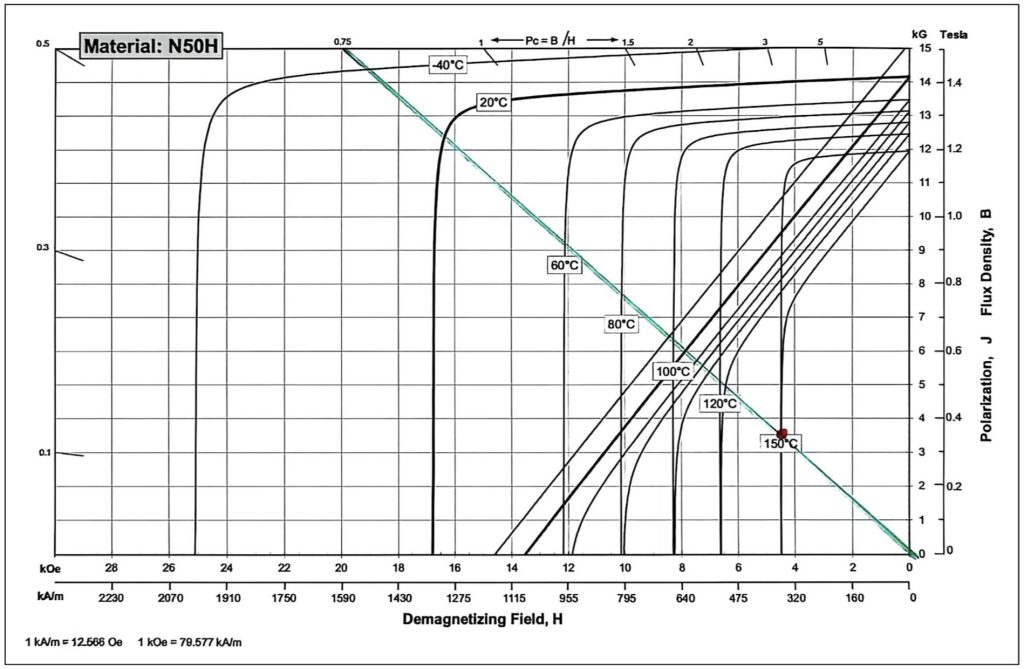
The first chart uses an H-grade NdFeB. Follow the green load line down to where it meets the 150°C curve, and the operating point sits well below 0.4 T. That’s a real loss compared to room temperature.
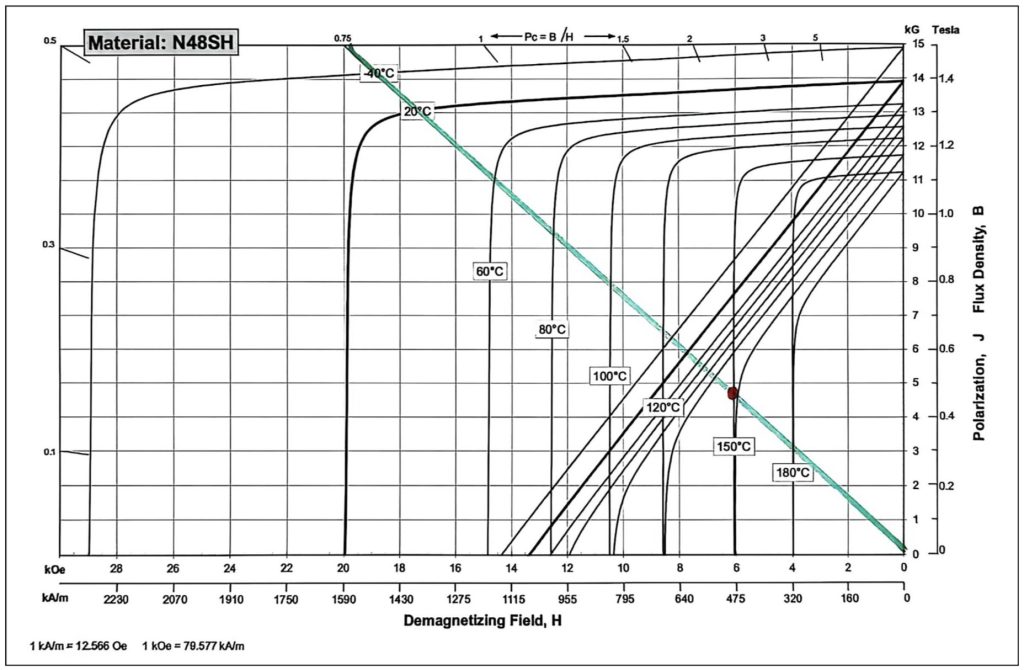
The second chart is an SH grade. Same load line, same Pc, same 150°C — but the operating point lands noticeably higher, closer to 0.45 T. Nothing changed except the material’s resistance to demagnetization. That’s the whole argument for a higher-coercivity grade in one picture: at room temperature the grades behave almost identically, but the gap opens up where it matters, under heat.
We laid both charts in front of the customer and let them decide. They went a step further than SH and chose a UH grade for extra margin — a few thousand dollars more in material, and worth it for a part that’s expensive to get wrong.
What we like about this one: nobody had to be talked into anything. A load line and two curves did the explaining. When an engineer can see why a grade matters, the conversation stops being about price and becomes about the right answer.