
Micro Magnets: Precision Engineered
Producing magnets below 0.20 mm is a battle against geometry, material limits, and physics itself. At MagnetPeak, we don’t just manufacture; we navigate these constraints with you. Whether it’s Neodymium (NdFeB) or Samarium Cobalt (SmCo), we believe in honest engineering: defining what is physically possible before you spend a dime.
But innovation hates waiting. We know that a custom micro magnet run typically starts at $1,000 with a 5–7 week lead time. That is a high barrier for early-stage validation.
To bridge this gap, we engineered a curated inventory of stock micro magnets ready to ship today. These aren’t generic components; they feature specialized coatings like Parylene-C/F, Gold, or Nickel — engineered for diverse demands, from biocompatibility in medical devices to environmental stability in precision sensors. You get the precision of a custom part, without the 7-week wait.
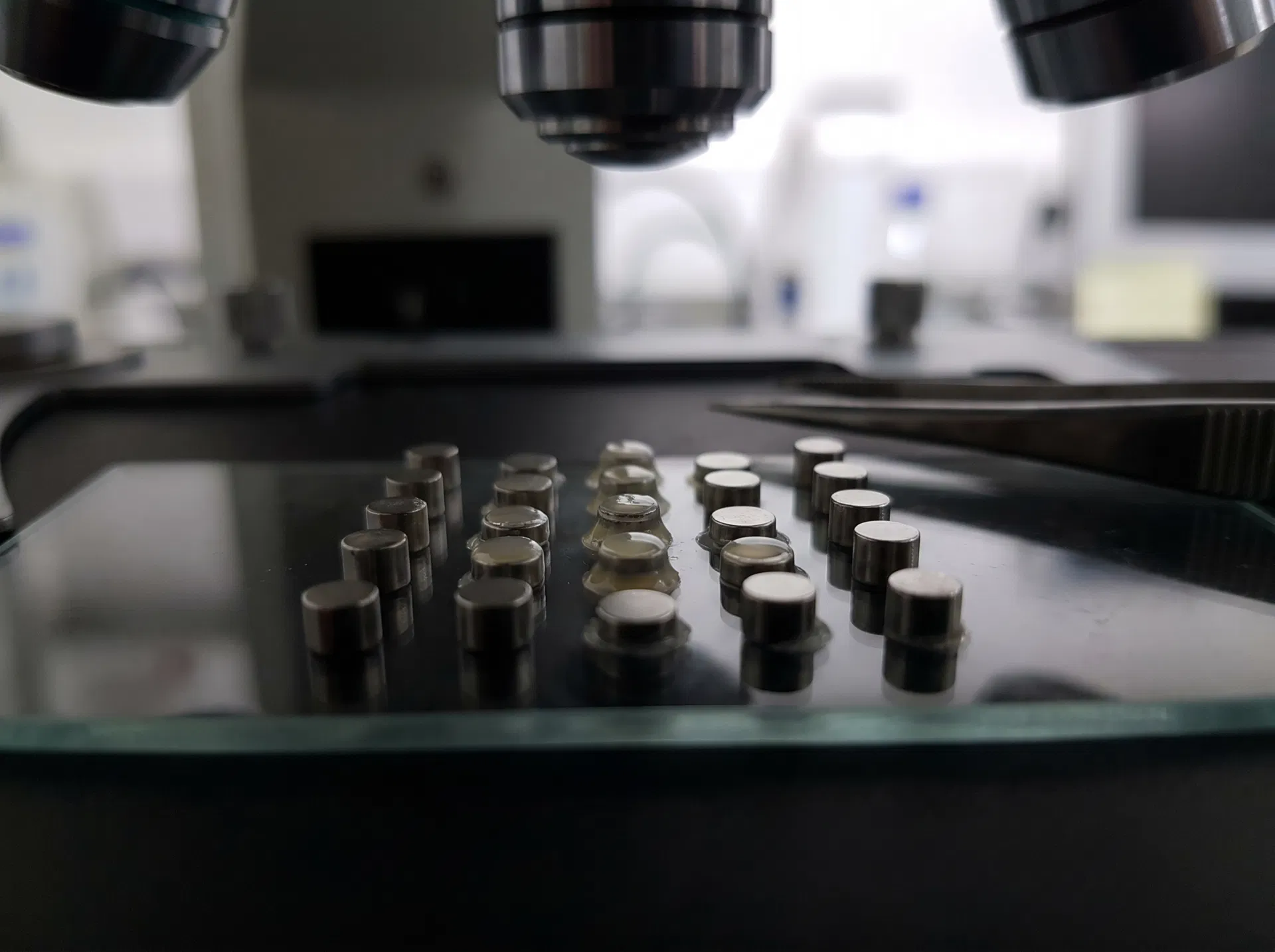
Available Specifications
Our stock inventory covers the most common micro magnet geometries. Custom dimensions outside these ranges are available — contact us with your drawings.
| Shape | Diameter / Size | Materials | Coatings Available |
|---|---|---|---|
| Sphere | 0.20 mm – 1.00 mm | NdFeB, SmCo | Parylene-C/F, Ni, Au |
| Disc / Cylinder | 0.30 mm – 1.00 mm Ø | NdFeB, SmCo, Ferrite | Ni-Cu-Ni, Ni-Ni, Epoxy |
| Block / Cube | 0.50 mm – 1.00 mm | NdFeB, AlNiCo | Ni-Cu-Ni, Parylene-C |
* Custom dimensions and grades available on request. Minimum order for custom runs typically starts at $1,000.
Defining the Micro Scale
In the era of extreme miniaturization, size is the defining constraint. At MagnetPeak, we define micro magnets typically as permanent magnets measuring below 1.00 mm, often reaching scales that require specialized handling and assembly techniques.
While the industry may refer to them as miniature magnets for their scaled-down geometry, or mini magnets in consumer electronics contexts, these components are far more than just small pieces of metal. They are high-density energy units. Despite their physical footprint, these tiny magnets pack a powerful magnetic punch, delivering the critical energy density to drive the next generation of technology.
This shift towards “smaller and stronger” is revolutionizing critical sectors. From advanced medical implants and catheters to wearable technology and robotics, the demand is for components that disappear into the design. Whether driving an actuator in a precision tool or triggering a Hall sensor in an automotive system, our micro series enables the innovations of tomorrow.
Material Selection Strategy
Material selection for tiny magnets is a balance of physical properties, focusing on magnetic strength, stability, and machinability.
| Material | Key Advantage | Best For |
|---|---|---|
| Neodymium (NdFeB) | Highest energy density | Maximum power in minimum volume |
| Samarium Cobalt (SmCo) | Superior thermal & corrosion stability | High-temperature and harsh environments |
| FeCrCo | Unique ductility — machinable | Complex shapes requiring precision machining |
| AlNiCo | Exceptional thermal consistency | Stable output across extreme temperature ranges |
| Ferrite | Chemically inert, electrically insulating | Cost-sensitive, corrosion-resistant applications |
Precision Fabrication of Micro Magnets
The manufacturing of micro magnets is fundamentally a challenge of precision machining. Because materials like Neodymium and Samarium Cobalt are inherently hard and brittle, processing them into extremely small dimensions requires rigorous control to prevent structural failure. Historically, this capability traces back to the quartz watch industry, where manufacturers adapted processing techniques from crystal manufacturing to produce the earliest miniature rotor magnets.
However, the physics of machining at this scale introduces unique performance issues. Post-processing, tiny magnets — particularly Neodymium — often exhibit magnetic properties that diverge noticeably from theoretical values. This discrepancy stems from the nucleation of magnetization reversal caused by surface oxidation and structural deformation during machining. In standard magnets, this damaged surface layer is negligible; but in mini magnets, this damaged volume represents a significant proportion of the total mass, meaning deterioration becomes exponentially more critical as size decreases.
This “size effect” actually paved the way for broader material science breakthroughs. Pioneering research by Dr. Masato Sagawa demonstrated that the intrinsic coercivity of Neodymium micro magnets could be restored by depositing a Dysprosium (Dy) film followed by heat treatment. This early work on repairing micro-scale surface damage is widely recognized as the illuminating contribution that eventually evolved into modern Grain Boundary Diffusion (GBD) technology.
Surface Engineering of Miniature Magnets
Protecting micro magnets presents a unique manufacturing challenge: agglomeration. In traditional liquid plating baths, the combination of fluid surface tension and residual magnetism causes tiny components to cluster together. This inevitably leads to uneven coating thickness, “bridging” between parts, and potential coating failure.
To address this for standard finishes like Nickel-Copper-Nickel (Ni-Cu-Ni) and Nickel-Nickel (Ni-Ni), we utilize specialized barrels. These custom barrels feature adapted mesh sizes and internal structures designed to promote better electrolyte flow and component separation, ensuring robust corrosion resistance and solderability. Spray epoxy coating remains another viable option for specific insulation requirements, applied via precision techniques to maintain dimensional control.
In addition to liquid-based processes, Parylene (chemical vapor deposition) serves as a robust alternative. Deposited as a gas, it eliminates liquid surface tension entirely. This results in a conformal encapsulation that is ideal for medical biocompatibility (USP Class VI) or high-voltage insulation, effectively bypassing the bridging issues inherent to wet processes.
Finally, for magnets at the extreme limits of miniaturization where any direct coating process might compromise tolerances or performance, we recommend an encapsulation strategy. In these cases, the raw magnet should be isolated within the device’s non-magnetic housing (e.g., Titanium or PEEK) to avoid direct contact with the external medium, effectively removing the need for surface treatment.
Critical Applications of Micro Magnets
Micro magnets are the invisible engines behind the world’s most precise technologies. While our components are microscopic, their impact is measurable across critical industries:
Medical Devices
Delivering consistent torque for insulin pumps, guiding intravascular catheters, and powering hearing aids where biocompatibility is non-negotiable.
Precision Optics
Enabling rapid auto-focus in voice coil motors (VCM) and ensuring signal stability in fiber optic isolators and switches.
Micro-Actuation
Providing the driving force for MEMS systems, miniature grippers, and high-precision stepper motors.
Handling Notes for Tiny Magnets
Working with magnets at this scale requires specific protocols to prevent damage. Standard ferrous tools are the primary cause of scrap during assembly. The strong magnetic attraction causes the micro magnet to “jump” and snap onto steel tweezers, frequently resulting in impact fractures or surface chipping due to the material’s inherent brittleness.
We strongly recommend using vacuum suction pens or non-magnetic tweezers (Titanium, Ceramic, or Carbon Fiber) for safe manipulation of micro magnets.