
A group at a European university wrote in looking for samarium-cobalt magnets. They study NV centers in diamond — quantum sensing work — and wanted a Halbach array that would hold a steady field of 500 gauss, within ±10%, in a small space at the middle of the ring. Enough room to slide a 4 mm diamond inside and move it around.
On paper, a small ask. It almost never stays that way, and this one didn’t.
We started with field direction. The easy way to build a Halbach, the one that gives you nice uniformity, has the field running across the ring. They wanted it running along the axis instead. That’s fine — but it always costs you. Same field, bigger magnet, higher price.
Then the part that catches people out: a low field that stays really uniform is harder to make than a strong one. To keep 500 gauss flat across a few millimeters, with room for the diamond and the optics, the bore had to get a lot bigger than they’d pictured. So we sized it up together, a bit at a time — inner diameter, wall, height — always working around the one number we couldn’t touch.
Funny thing: most of the back-and-forth wasn’t about magnets at all. It was about how they’d mount it. Their whole optical setup sits on a cage-and-rod system, everything lined up on one axis so a laser can run straight down the middle. So the steel sleeve needed through-holes for the rods, side holes for set screws, threaded holes for the table — all of it lined up exactly. We swapped sketches until it matched their bench. Get that wrong and you ship a part that’s perfectly made and still useless to them.
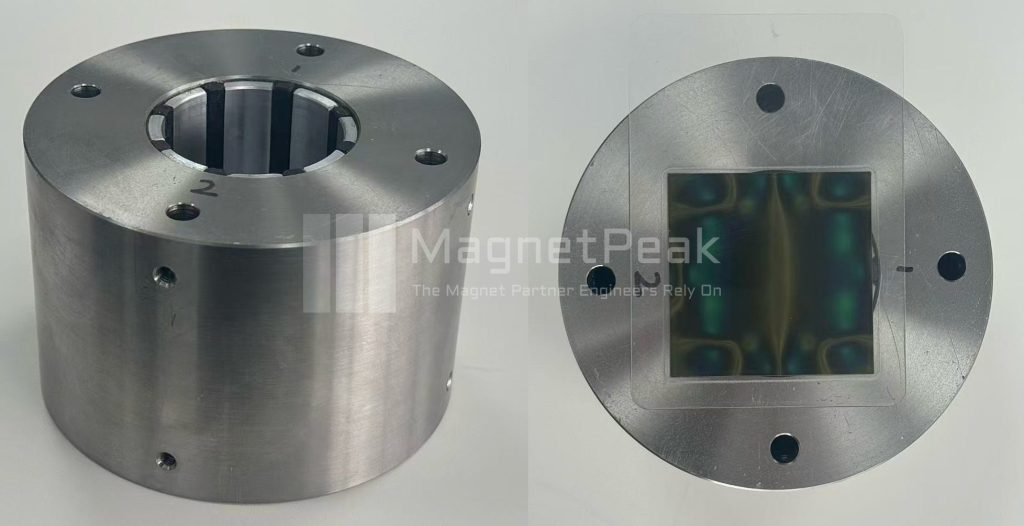
Then we built it. The first one came back at about 430 gauss — dimensions spot on, uniformity fine, but the field landed below the ±10% window. That happens. Chamfers, tolerances, coating, glue: each one shaves a little off, and the real part never matches the simulation exactly.
So we told them straight. 430, under target, here’s a photo — keep it, or remake it? They came back wanting 470 to 490, so we made it again. The second one hit about 530 in the center, comfortably inside the 500 ±10% band. Handed it to the forwarder; tracking to follow.
Two things to carry into the next one. First, the spec being a range and not a single number is what made this finishable — 500 gauss ±10% left us room that a fixed value at the dead center never would have. Second, the mounting matters as much as the magnet. The field was never what nearly went wrong here. The holes were.