
What Are Halbach Rotors?
Halbach rotors are magnetic rotor structures that use a Halbach arrangement of magnet segments to concentrate magnetic flux toward the working air gap while reducing flux on the opposite side. In motor design, this arrangement can help increase air-gap flux density, reduce dependence on heavy back iron, and support more compact rotor structures.
However, Halbach rotors are not just special magnet arrangements. In real projects, they are complete rotating components that involve magnet segmentation, magnetization directions, machining tolerance, adhesive bonding, sleeve retention, rotor dynamics, balancing, and magnetic verification.
This is why custom Halbach rotor assemblies require more than supplying arc magnets. The design must be reviewed as a full rotor system, especially when it is used in compact, high-speed, or high-performance motor applications.
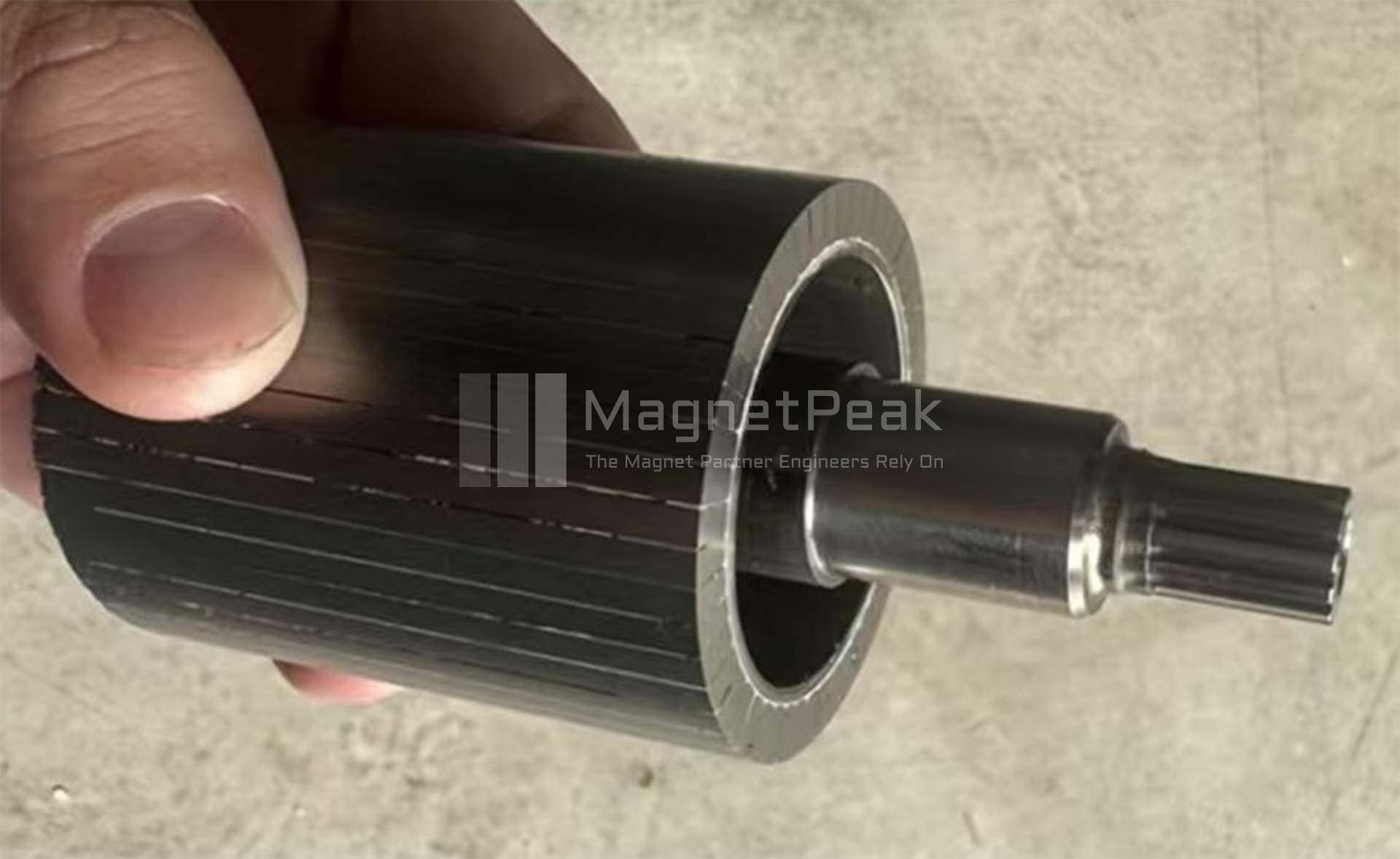
Why Halbach Rotors Are Used in Compact Motor Design
Halbach rotors are often considered when a motor design needs stronger magnetic output within limited space. By arranging magnet segments in a Halbach configuration, more magnetic flux can be directed toward the working air gap, which can help improve the effective magnetic field available to the stator.
This makes Halbach rotors attractive for compact motor designs where rotor diameter, weight, inertia, and magnetic efficiency are all important. In some designs, the reduced flux on the opposite side may also reduce the dependence on heavy back iron, helping the rotor structure become lighter and more responsive.
However, the benefit is not automatic. A Halbach rotor only makes sense when the magnetic gain is worth the added manufacturing difficulty, assembly cost, and mechanical retention requirements. For MagnetPeak, this is where feasibility review becomes important: the rotor must be evaluated as both a magnetic circuit and a rotating mechanical component.
The Hard Part Is Not the Halbach Idea
The basic idea behind Halbach rotors is easy to understand: arrange magnet segments in different magnetization directions so that more magnetic flux is directed toward the working side. The difficult part is turning this idea into a rotor that can be manufactured, assembled, balanced, and used reliably.
In real projects, the segment design must match both the magnetic target and the production process. Each magnet segment may have a different magnetization direction, and small errors in machining, marking, positioning, or bonding can affect the final magnetic field and rotor consistency.
The assembly process can also be challenging because magnet segments do not simply stay in place by themselves. Strong attraction and repulsion forces may appear during assembly, especially when high-grade Neodymium magnets are used. Proper fixtures, adhesive control, curing process, and inspection steps are needed to keep the rotor accurate and repeatable.
For this reason, MagnetPeak does not treat Halbach rotors as a simple magnet supply project. The magnetic design, mechanical structure, assembly method, and verification plan need to be considered together before production begins.
Segmentation Count: More Is Not Always Better
Increasing the number of magnet segments is a common way to make Halbach rotors closer to the ideal magnetic flux distribution. In theory, more segments can create a smoother magnetic field, improve air-gap flux density, and reduce unwanted field distortion.
But in real production, more segments are not always the better choice. Each additional segment adds another machined part, another magnetization direction, another orientation mark, and another bonding surface. As the segment count increases, the rotor becomes more sensitive to machining tolerance, magnetization angle error, adhesive thickness, positioning accuracy, and cumulative assembly error.
This is why a design that looks better in simulation may not always be the best design for manufacturing. A higher segment count may improve the magnetic approximation, but it can also raise cost, lead time, assembly risk, and inspection difficulty.
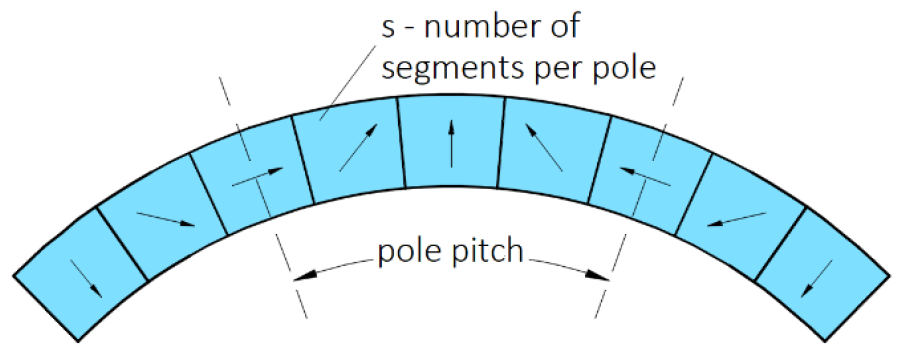
For MagnetPeak, the key question is not simply how many segments can be used. The better question is whether the additional segments create enough magnetic value to justify the added manufacturing complexity. A good Halbach rotor design should balance field performance, segment geometry, assembly feasibility, retention method, and inspection requirements from the beginning.
Retention Design for High-Speed Halbach Rotors
For high-speed Halbach rotors, magnetic performance is only one part of the design. The magnets also need to stay safely in position during rotation. Once rotor speed increases, centrifugal force, vibration, thermal expansion, and bonding stress can become as important as the magnetic circuit itself.
This is why retention design cannot be treated as an afterthought. Depending on the rotor size, operating speed, temperature, and mechanical structure, the retaining method may involve carbon fiber sleeves, non-magnetic metal sleeves, adhesive bonding, or a combined support structure.
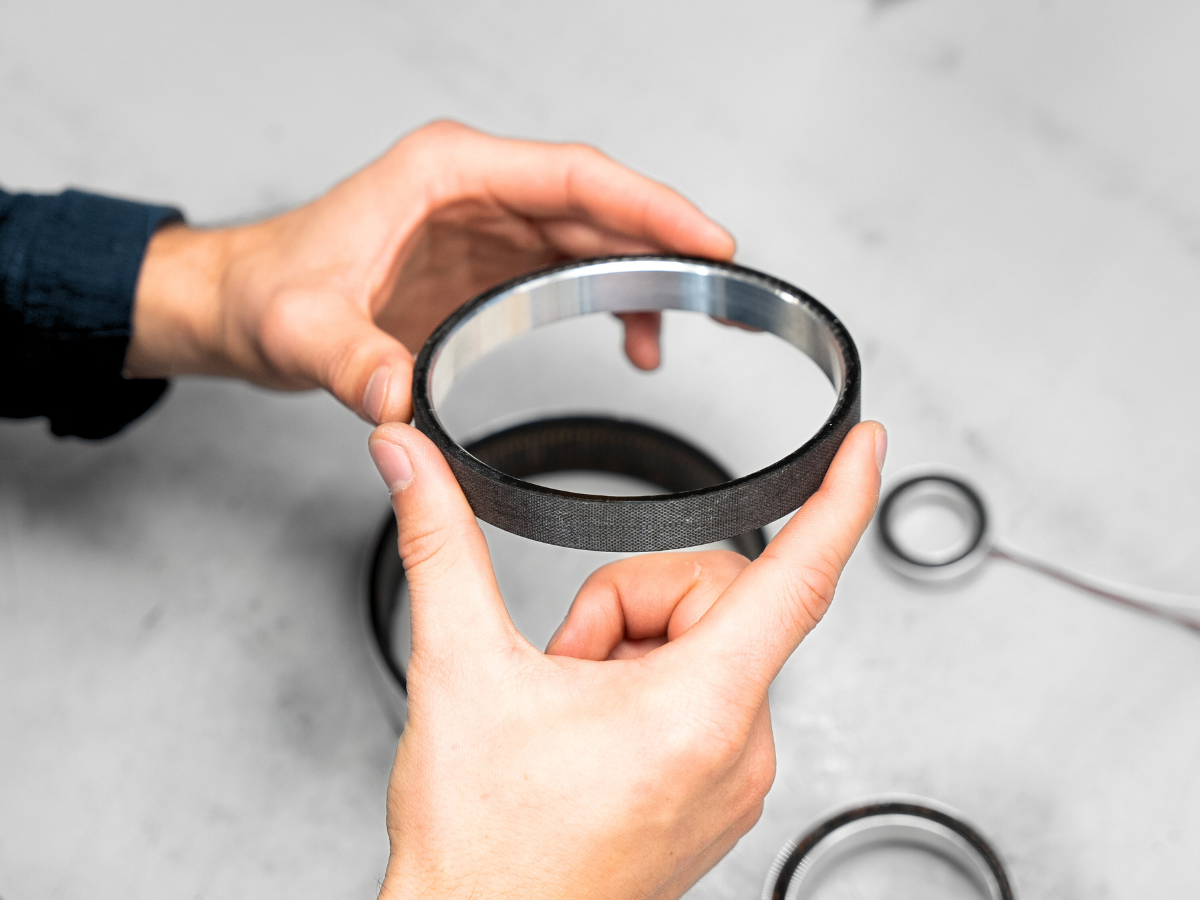
The choice of sleeve material also affects the final rotor design. Carbon fiber can provide high strength with low weight, while non-magnetic metallic sleeves may offer better dimensional control, protection, or manufacturing convenience in some projects. However, sleeve thickness, assembly clearance, adhesive layer, and thermal behavior all need to be considered because they can influence the effective air gap and final motor performance.
For MagnetPeak, retention is not just a protective layer around magnets. It is part of the rotor system. Before recommending a high-speed Halbach rotor structure, we review the magnetic layout, sleeve space, bonding method, operating temperature, speed requirement, and inspection plan together. This helps avoid designs that look strong magnetically but become risky or unrealistic mechanically.
What MagnetPeak Reviews Before Recommending Halbach Rotors
Not every Halbach layout should move directly into production. Before recommending a design, MagnetPeak first reviews whether the rotor is magnetically useful, mechanically realistic, and manufacturable within the expected budget and tolerance range.
The review usually starts with the basic rotor information: outer diameter, inner diameter, stack length, pole count, air-gap requirement, target speed, working temperature, and available space for sleeves or other retaining structures. These parameters decide whether the proposed magnetic structure has enough room to work as intended.
The next step is to check the magnet segments themselves. Segment geometry, magnet material, grade, magnetization directions, machining tolerance, coating, adhesive compatibility, and assembly sequence all affect the final rotor quality. Even a small change in segment size or orientation control can influence the magnetic field and assembly repeatability.
MagnetPeak also considers verification from the beginning. Depending on the project, this may include dimensional inspection, magnetic field mapping, bonding review, sleeve inspection, balancing requirements, or prototype testing. The goal is not only to make the rotor look correct on paper, but to make sure the finished component can be assembled, inspected, and used with confidence.
Halbach Rotor vs. Conventional Surface-Mount Rotor
A Halbach rotor is one possible solution, not the only one. The table below compares a segmented Halbach rotor with a conventional surface-mount arc-magnet rotor so engineers can evaluate which structure fits the project better.
| Aspect | Halbach Rotor | Conventional Surface-Mount Rotor |
|---|---|---|
| Air-gap flux density | Higher, more directional | Moderate, depends on back iron |
| Back iron requirement | Reduced or eliminated | Usually required |
| Rotor weight / inertia | Lower potential, especially with carbon sleeve | Higher, due to back iron |
| Magnet segments per pole | Typically 2–5, with different orientations | 1 arc per pole, single orientation |
| Assembly difficulty | High — orientation control, fixtures, bonding | Lower — standard arc bonding |
| Retention method | Carbon fiber or non-magnetic metal sleeve usually required | Sleeve optional, depends on speed |
| Cost | Higher per rotor | Lower per rotor |
| Lead time | Longer — engineering review, tooling, inspection | Shorter — established process |
| Best fit | Compact, high-speed, slotless, or weight-sensitive motors | Standard PMSM / BLDC where space allows |
Where Halbach Rotors Make Sense
Halbach rotors make the most sense when a motor design needs higher magnetic output within limited rotor space. They are often considered in compact motor systems where air-gap flux density, rotor weight, inertia, and response speed all matter.
They can also be useful in high-speed or high-performance motor projects where reducing unnecessary rotor mass is valuable. In some designs, the Halbach arrangement may reduce the need for heavy back iron, helping the rotor become lighter while keeping useful magnetic flux directed toward the working air gap.
Another suitable direction is motor designs that require a smoother working-side magnetic field or a more compact magnetic circuit. This may include slotless motor structures, lightweight rotating systems, precision motion applications, or other projects where rotor dimensions, air-gap performance, and mechanical balance must be considered together.
However, Halbach rotors should not be selected only because they look advanced. The design only makes sense when the magnetic gain, space saving, weight reduction, or performance improvement can justify the added cost and manufacturing complexity. In many projects, a conventional rotor with well-designed arc magnets may still be the better commercial choice.
When Halbach Rotors Are Not the Right Shortcut
Halbach rotors are not the right answer for every motor project. If the required performance can already be achieved with well-designed arc magnets, multipole ring magnets, or another conventional rotor structure, switching to a Halbach arrangement may only add unnecessary complexity.
Cost-sensitive projects are usually the first case where caution is needed. Halbach designs often require more magnet segments, more controlled magnetization directions, tighter assembly steps, and additional inspection. If the performance improvement is limited, the extra manufacturing cost may not be justified.
They may also be unsuitable when the available rotor space is too restricted to support the complete structure. Magnet thickness, adhesive layer, sleeve allowance, air gap, shaft or hub design, and balancing requirements all need space. A design that only considers the magnet layout but ignores the full rotor structure can become unrealistic very quickly.
In some compact motor designs, multipole ring magnets may provide a simpler and more repeatable solution than a segmented Halbach structure, especially when the magnetic field requirement is not extreme. This is why the best solution is not always the most complex magnetic arrangement, but the structure that can meet the target with the right balance of performance, manufacturability, and reliability.
High-speed projects require even more caution. Without a proper retaining structure, bonding process, and mechanical review, a magnetically attractive design may become risky during rotation. In these cases, the question is not whether Halbach rotors are advanced, but whether the complete rotor can be manufactured, retained, balanced, and verified safely.
For MagnetPeak, saying “not recommended” is sometimes part of the engineering process. The goal is not to force every project into a Halbach layout, but to find the magnetic structure that makes the most sense for the required performance, budget, and manufacturing reality.
QUICK FACTS
- Magnet materials NdFeB, SmCo
- Typical grades N42SH, N45SH, N48H, N52H, N35EH, Sm2Co17
- Segments per pole typically 4–8
- Retention options carbon fiber sleeve, non-magnetic metal sleeve, bonded
- Typical OD range 20–150 mm (custom)
- Verification dimensional, field mapping, balancing
- Custom lead time 6–8 weeks (prototype), 8–10 weeks (production)
- Custom MOQ from $4,000 (includes engineering review)
Custom Halbach Rotors from MagnetPeak
MagnetPeak supports custom Halbach rotors for projects where magnetic performance, rotor dimensions, assembly difficulty, and mechanical reliability must be reviewed together. These projects usually require more than selecting a magnet grade or supplying several arc magnets.
Our work starts with feasibility review. We look at the target magnetic output, rotor size, pole structure, operating speed, temperature, available sleeve space, magnet segment geometry, and inspection requirements before recommending a practical route. The goal is to understand whether the proposed Halbach structure can be manufactured, assembled, retained, and verified with reasonable process control.
For segmented designs, MagnetPeak can help review magnet material, grade selection, magnetization directions, coating, machining tolerance, bonding method, assembly sequence, and retaining structure. When needed, we also review carbon fiber sleeves, non-magnetic metal sleeves, prototype inspection plans, dynamic balancing requirements, and magnetic field consistency verification, so the finished rotor can be evaluated as both a magnetic component and a rotating mechanical part.
Custom Halbach rotor assemblies are not standard commodity parts. Small changes in segment design, adhesive layer, sleeve thickness, or orientation control may affect the final magnetic field and mechanical safety. This is why early engineering communication is important before the project moves into production.
Send us your rotor drawings, target speed, pole count, working temperature, air-gap requirement, and expected production volume. MagnetPeak will help review whether Halbach rotors are the right solution, or whether another magnetic structure may achieve the required performance with lower manufacturing risk.