
A few days ago, we got an interesting inquiry from a research group working on polarized helium-3 (³He). Their goal wasn’t the usual one: they weren’t looking for a strong magnetic field. Instead, they needed a strong magnetic field gradient.
The target was roughly 40 T/m over a working region on the order of several centimeters. The sample itself would be heated during the experiment to increase thermal motion. By carefully tuning the magnetic field gradient, they hope to use room-temperature ³He gas as an analog system for studying depolarization processes that occur in much more extreme environments.
The basic idea is elegant. A helium-3 atom moving through a spatial magnetic field gradient experiences a changing magnetic field over time. If that field-change rate matches what a fast ion would experience in a fusion-relevant environment, the depolarization dynamics can be studied under ordinary laboratory conditions rather than inside a plasma device.
Their requirements were unusual in a few ways:
- The absolute magnetic field strength wasn’t important.
- The field gradient was the key parameter.
- They wanted a reasonably large working volume, ideally around 50 mm in size.
- They preferred to avoid any zero-field point inside the sample region because that can introduce additional depolarization mechanisms.
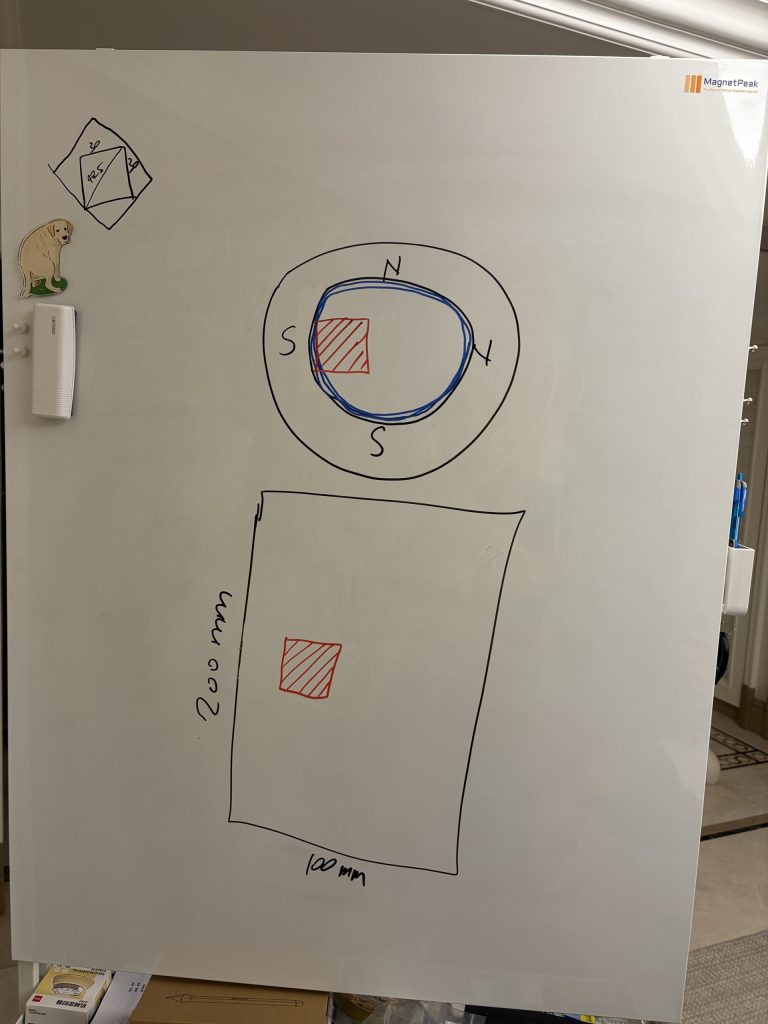
The first concept we discussed was a permanent-magnet assembly with shaped pole pieces. The overall package size was constrained to roughly Ø100 × 200 mm, which immediately made the problem more interesting. Large gradients are easy to write down on paper; generating them across a useful volume is another matter.
One of the early design questions was whether a 4-pole or 6-pole geometry would be the better choice. Rather than arguing theoretically, we ran preliminary simulations on both.
The results were informative.
The 4-pole design produced a relatively broad usable region but topped out around 28 T/m, significantly below the target.
The 6-pole design pushed much closer to the requirement. In simulation it could approach 40 T/m, although we expected the real-world value to be somewhat lower after accounting for manufacturing tolerances, magnet variation, and practical assembly effects. The tradeoff was a narrower high-gradient region.
That tradeoff is common in gradient magnet design: higher gradients usually come at the expense of usable volume.
At the time of writing, the concept was still in the simulation stage. We hadn’t yet proven that the required gradient could be maintained across the full desired sample volume. That’s exactly the sort of uncertainty we like to leave visible in these notes. Sometimes a design works immediately. Sometimes the physics pushes back.
This one sits somewhere in between.
The next step was straightforward: refine the 6-pole geometry, verify the field quality across the entire sample region, and see whether the experimental requirements could be met without introducing unwanted low-field regions.
We’ll share more if the design progresses beyond the initial modeling phase.